



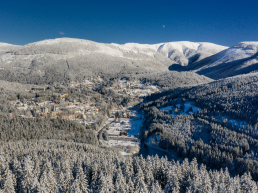


Špindlerův Mlýn was founded in the second half of the 18th century as a settlement of miners who mined mainly gold and silver. The name of the village was derived from the mill of the miller Špindler, where the locals met and from where they asked the emperor for permission to build a church. This was granted to them in 1793 by Emperor Francis I. , and in the document the place was designated as "Spindelmühle", from which the present name of the town was derived.

Church of Saint Peter
The first chapel was in the Svatý Petr valley, where it was built by the original settlers - mainly miners who came here to mine gold and silver. As early as 1793, they built a small wooden church here and transferred services from Svatý Petr; the original chapel, founded by Count Rudolf Morzin in the 17th century, was later demolished.
The settlers met at the mill of the miller Špindler, from where they sent a request to the emperor for permission to build a brick church, which enabled the further development of the settlement. This request was granted by Emperor Francis I , and a new church was built in the years 1802–1807.
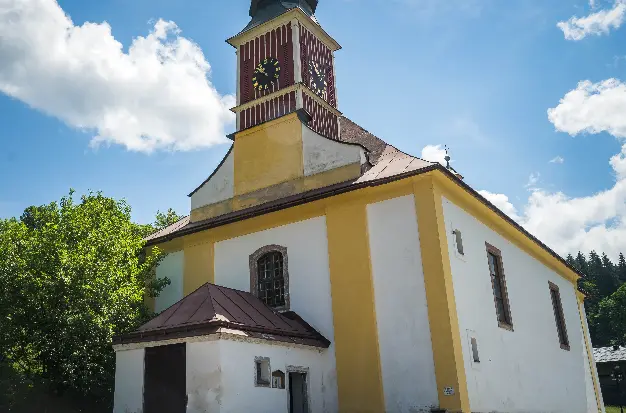
The construction was carried out by the builder Weiss from Vrchlabí together with the master carpenter Erben on the site between the original wooden church and the old hunting lodge. The church was dedicated to Saint Peter and is a classicist, single-nave building with a polygonal presbytery and a sacristy on the north side. The facade is decorated with a prismatic tower, the walls are divided by pilasters and the windows have segmental ends.
.webp)
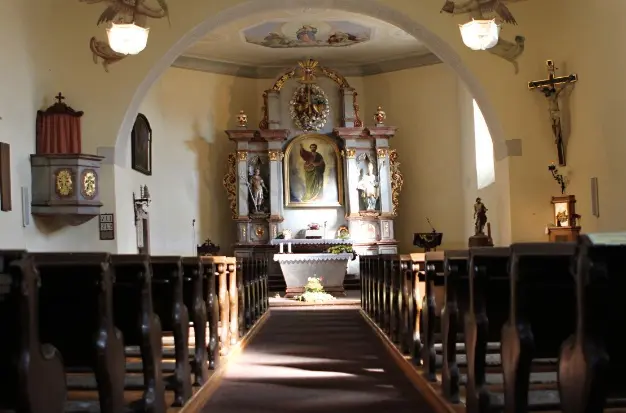
Church interior
The interior has flat ceilings with paintings of the four evangelists from the 20th century and preserved classicist furnishings. The main altar is complemented by statues of St. Adalbert and St. Florian with a scene of the Holy Trinity, and a valuable element is also the Baroque statue of St. John of Nepomuk from the 18th century.
Present
The Church of St. Peter has survived to this day without major structural modifications and is in very good condition. Since 2006, it has been part of the Roman Catholic parish of Vrchlabí , where the local spiritual administrator, Dean Jiří Šlégr , also works. Regular services are held here every Sunday, supplemented by important holiday masses, including the traditional midnight mass. The church is not normally open every day, it is accessible mainly during the time of services. A tour can be arranged by prior arrangement through Eljon .


 Walking
- Travel destinations
- Other


